Is something wrong right now? If your pet is struggling to breathe, has collapsed, is bleeding heavily, cannot pass urine, has a swollen hard abdomen, is having a seizure, has been hit by a car, or has swallowed something you think is poisonous, this is an emergency. Call us before you set off so we can be ready for you, and if we are closed call a 24-hour emergency hospital straight away. Do not wait to see whether it settles. Call 000-000-0000
Anaesthesia is not a single moment but a period that starts before your animal arrives asleep and continues until they are fully awake and warm again, and every stage of it is watched by a person rather than left to a machine sounding an alarm after the fact. Pre-anaesthetic blood tests tell us whether an animal's organs are able to process and clear the drugs involved before anything is given. Tomas Brennan, our anaesthesia and surgical technician, monitors continuously through the procedure itself, and his only task for that hour is the animal on the table, not the next patient and not the phone.
Five things are tracked throughout, on a monitor and on a paper chart kept alongside it: heart rhythm by continuous ECG, blood pressure, the oxygen carried in the blood, the carbon dioxide breathed out with every breath, and body temperature. Anaesthetised animals lose heat quickly, and a cold animal recovers badly, so active forced-air warming runs throughout the procedure and into recovery rather than being added afterwards if somebody happens to notice a chill. None of this is unusual, and it is not a sign that your animal has been judged a difficult case — it is what happens for every anaesthetic here, every time, without exception.
Anaesthesia carries real risk, and a practice that tells you otherwise is not being straight with you; what we will not do is hand you a percentage, because a single number cannot describe your animal's actual age, breed, weight and health set against the specific procedure planned. Instead we go through your animal's own pre-anaesthetic results with you, explain plainly what they mean for the plan, and answer every question before you sign anything. Recovery happens on a heated bed in a quiet ward with a person present, not a monitor left to page somebody. See /facility.html for the recovery ward itself and /team.html for who is in the room.
Before your animal is ever asleep
Most of what determines how an anaesthetic goes is decided before the first drug is given.
Pre-anaesthetic blood testing
A blood panel taken before anaesthesia checks how well the liver and kidneys are working, because those are the organs that process and clear anaesthetic drugs afterwards. For a young, healthy animal having a routine procedure it is a sensible precaution; for an older animal, or one with an existing condition, it becomes a genuine part of deciding the safest plan rather than an optional extra. We will tell you plainly which category your animal falls into and why, rather than selling it as a blanket rule for everyone.
The physical examination and an honest risk conversation
Every animal is examined and assigned a risk category before anaesthesia is booked, based on age, breed, weight, existing conditions and the procedure planned, and that category shapes the monitoring and drug plan used on the day. We will talk you through what we found and what it means in plain terms, including when the honest answer is that a higher-risk animal needs a more cautious approach rather than a different practice altogether.
A pre-medication to settle your animal before induction
Most animals are given an injection beforehand that reduces anxiety and lowers the amount of anaesthetic needed later, so the transition into unconsciousness is calmer and gentler than going straight from an anxious, wide-awake animal to a fully anaesthetised one. Exactly what is used and how much is a clinical decision made and recorded by the veterinarian on the day, matched to your animal specifically, not a fixed recipe applied to every patient regardless of size or condition.
An intravenous catheter, placed before anything else
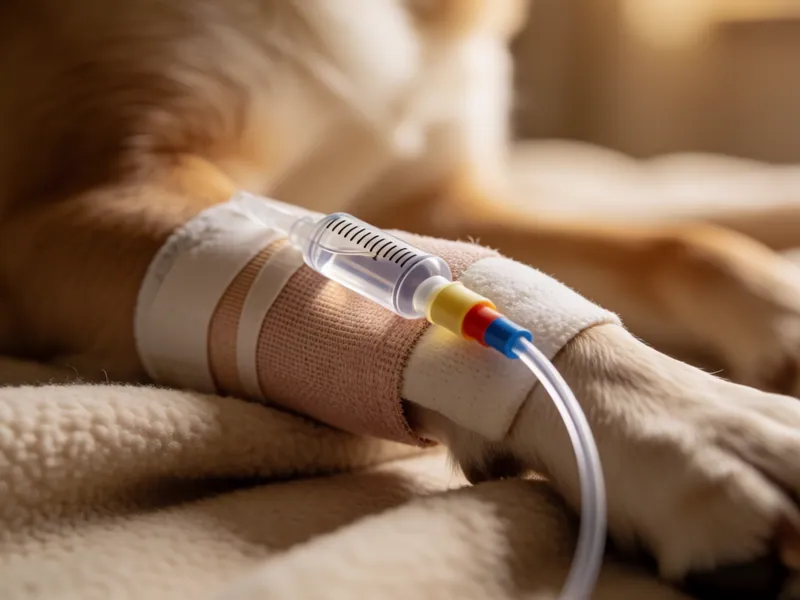
A small catheter is placed in a vein, almost always in a front leg, before induction begins, giving immediate access for the anaesthetic itself, for fluids to support blood pressure throughout, and for an emergency drug to be given instantly if it is ever needed. It stays in place through recovery, which is also why most animals go home with a small shaved patch and a light bandage that can be removed the next day.
A written estimate that already includes the anaesthetic
Anaesthesia and monitoring are never a surprise line added afterwards — they are built into the estimate for the procedure itself before anything is booked, alongside pre-anaesthetic bloods if we are recommending them for your animal. If anything changes once your animal is asleep and the plan needs to change with it, we stop and call you before continuing, exactly as we would for any other procedure.
What is actually watched, and by whom
Five measurements, tracked continuously, by a person whose only job that hour is your animal.
One technician, one animal, for the whole procedure
Tomas Brennan, our anaesthesia and surgical technician, or another technician trained the same way, is assigned to a single anaesthetic at a time and does nothing else for its duration — not admitting the next patient, not answering the phone, not assisting elsewhere. That single-minded attention is not a luxury; it is the reason a slow, subtle change gets caught in the minute it starts rather than the minute an alarm finally sounds.
Heart rhythm and blood pressure, tracked continuously
A continuous ECG shows the heart's electrical rhythm beat by beat, catching irregularities long before they would be audible with a stethoscope alone, while blood pressure is measured repeatedly throughout to confirm that organs are actually being supplied with blood rather than simply that the heart is beating. Together they answer a more useful question than either one alone: not just whether the heart is working, but whether it is doing its job properly.
Oxygen saturation and capnography
A pulse oximeter measures how much oxygen the blood is actually carrying, while capnography measures the carbon dioxide breathed out with every single breath, confirming that the airway is clear and that breathing is adequate rather than merely present. The two together catch different problems — one is about oxygen going in, the other about carbon dioxide coming back out — and a change in either is visible on the monitor well before it would be visible on your animal.
Temperature and active warming
Body temperature is tracked throughout, because anaesthetised animals cannot shiver to warm themselves and lose heat quickly on a cold table, and a cold animal both anaesthetises unpredictably and recovers badly. Active forced-air warming runs from before induction through recovery, not added reactively once somebody notices a chill, which is the difference between preventing a problem and chasing one that has already started.
A paper record as well as a machine trace
The monitor's own trace is backed up by a handwritten chart kept alongside it, updated every few minutes throughout the procedure, on the reasoning that a machine that stops working correctly is not a reason to stop knowing what your animal is actually doing. That paper record becomes part of your animal's permanent file, so the next anaesthetic, if there is one, starts from real information rather than a memory of how the last one went.
After anaesthesia — recovery, and the honest conversation about risk
Waking up matters as much as going to sleep, and it gets exactly as much attention.
The recovery ward itself
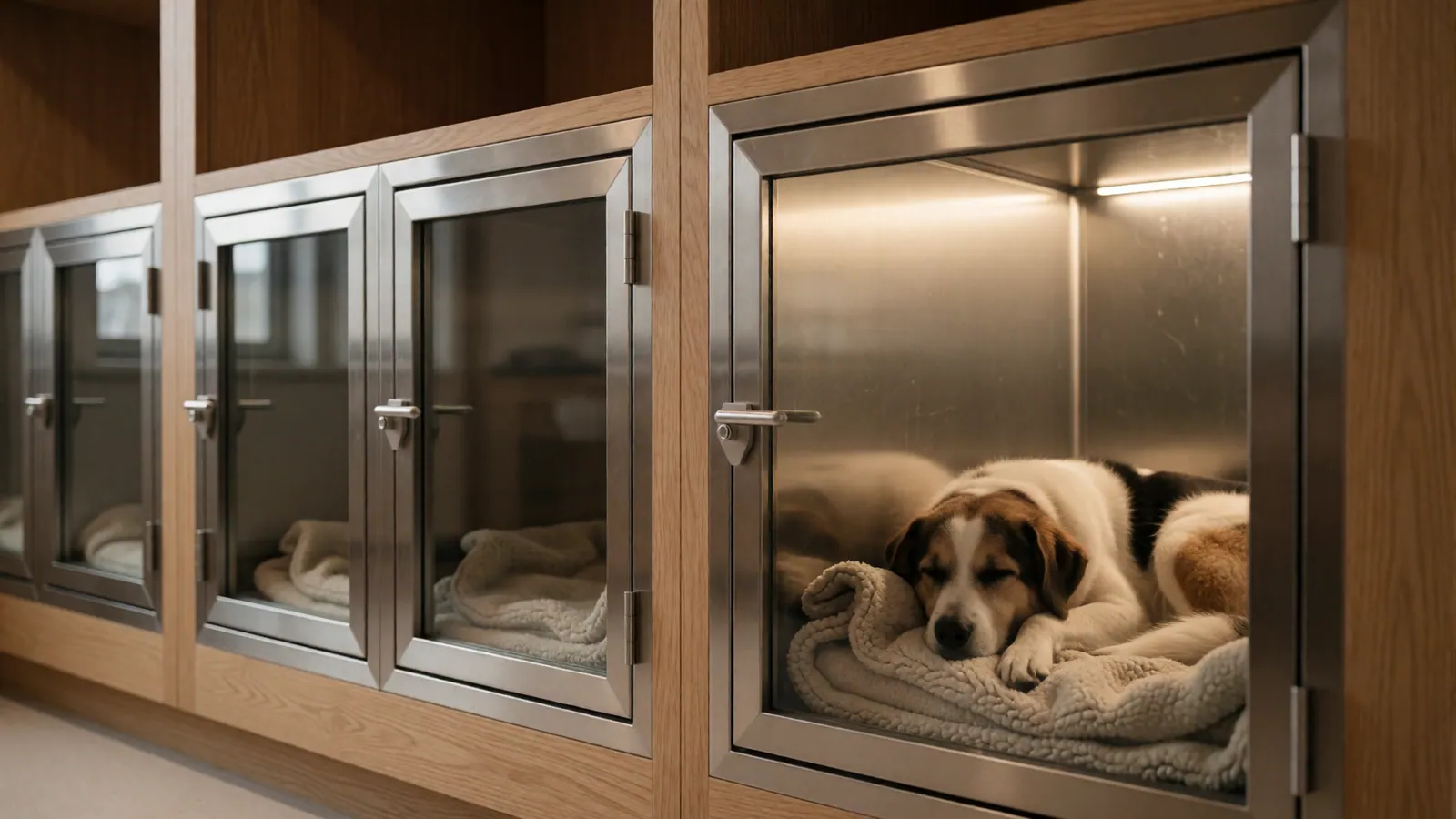
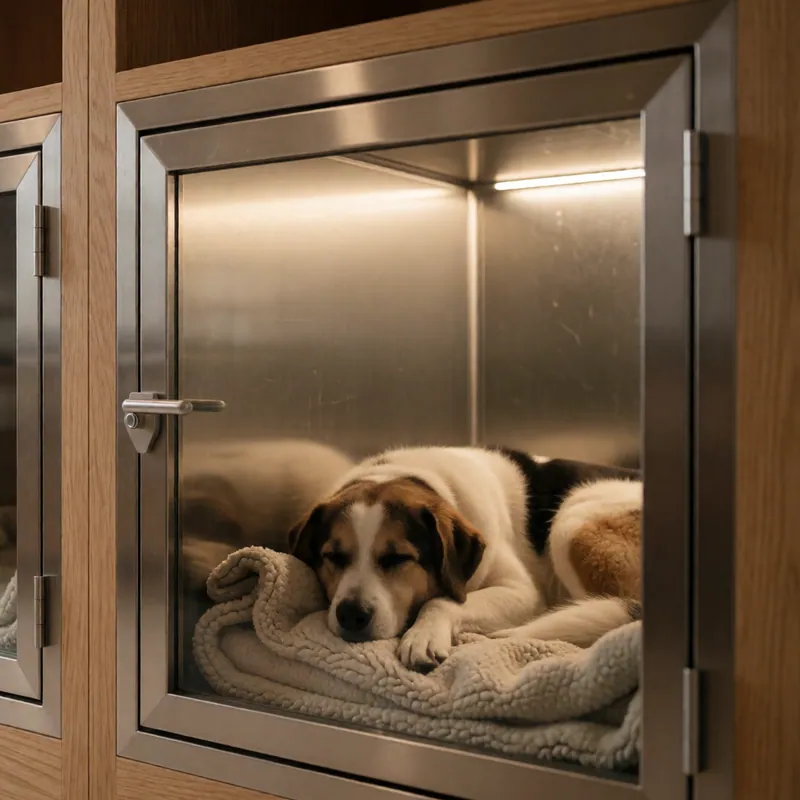
Recovery happens on a heated bed in a quiet, dimly lit ward with a person present the entire time, not a corridor cage checked on periodically between other jobs. Lighting is kept low because a bright room disorients an animal that is still partly under the effect of the drugs, and the same technician who monitored the procedure often stays with your animal into the early part of recovery rather than handing off to someone unfamiliar with the case.
What a normal recovery looks like
Most animals are groggy, uncoordinated and want to sleep for the first hour or two, then gradually become more like themselves — sitting up, responding to their name, showing interest in water. We will tell you honestly when your animal is ready to go home rather than to a fixed clock, and we would rather keep an animal a little longer than send them home before they can walk to the car safely.
What to watch for once you are home
Some grogginess and reduced appetite on the evening of a procedure is normal; persistent vomiting, distress, a wound that is bleeding or swelling, or an animal that will not settle at all is not, and any of those is a reason to call us or, if we are closed, a 24-hour hospital. We will give you a written list of what to expect specific to your animal's own procedure before you leave.
Why we will not quote you a survival percentage
Anaesthesia carries genuine risk, and that risk is different for a young healthy cat having a routine procedure than for an elderly dog with heart disease having emergency surgery — a single number cannot honestly describe both situations, so we do not offer one. What we will do is walk through your animal's specific risk factors with you, plainly, and answer every question before you sign a consent form, rather than reduce a real decision to a figure that sounds reassuring and means very little.
Questions welcome before, not just after
Ask anything before you consent — what is monitored, who is watching, what the pre-anaesthetic bloods showed, or what happens if something changes partway through — and expect a real, specific answer rather than a vague reassurance that everything will be fine. See /team.html for who is actually on the anaesthesia team, and /pain-management.html for how pain is managed once your animal is awake again.
Anaesthesia & Monitoring in western Queens
Continuous ECG, blood pressure, oxygen and temperature monitoring on every anaesthetic, watched by a named technician whose only task for that hour is your animal, with active warming throughout.
It starts the same way whatever you are here for: a full examination with time to talk, what we found explained in plain English, and a written estimate for anything beyond the consultation before it happens. You are entitled to take that estimate away and think about it, and to ask what happens if you do nothing. That last one is a real question and it gets a real answer.
This is general information, not veterinary advice. This page describes a service. It is general information and it is not veterinary advice, a diagnosis or a treatment plan for any particular animal, because no page can examine your pet. If your animal is unwell, injured or behaving unusually, speak to a licensed veterinarian who can actually see it. In an emergency contact your own veterinarian or a 24-hour emergency animal hospital immediately.
Questions
Anaesthesia & Monitoring — the questions we are asked most
Is anaesthesia safe for my pet?
Anaesthesia carries real risk, and we will not tell you otherwise or offer you a reassuring percentage, because a single number cannot describe your animal's specific age, breed, health and procedure. What we can tell you is exactly what is done to make it as safe as it can be for your animal in particular: a pre-anaesthetic assessment, continuous monitoring by a named technician, active warming, and a written plan built around what we actually find, discussed with you honestly before you agree to anything.
What is pre-anaesthetic blood testing, and does my animal need it?
It is a blood panel taken before anaesthesia to check how well the liver and kidneys are working, since those organs process and clear the drugs used. For a young, healthy animal it is a sensible precaution; for an older animal, or one with an existing condition, it becomes a genuinely important part of planning a safe anaesthetic rather than an optional add-on. At $130, it is the same in-house panel used for any blood work, read specifically with anaesthesia in mind, with most results back the same day.
Who actually watches my animal while they are under anaesthetic?
Tomas Brennan, our anaesthesia and surgical technician, or another technician trained the same way, is assigned to a single anaesthetic at a time and does nothing else for its duration. A monitor tracks heart rhythm, blood pressure, oxygen, breathing and temperature continuously, and a handwritten paper chart is kept alongside it, because a technician watching in person catches a slow change long before a machine's alarm would.
What is actually monitored during anaesthesia?
Five things, continuously: heart rhythm by ECG, blood pressure, oxygen saturation, capnography — the carbon dioxide breathed out with each breath — and body temperature, alongside active forced-air warming throughout the procedure and into recovery. Each measurement answers a slightly different question about how your animal is doing, and together they let a change be caught within minutes rather than discovered afterwards.
Will my animal be cold or in pain when they wake up?
Active warming runs from before induction through recovery, so animals do not wake up cold, and pain relief appropriate to the procedure is given before your animal wakes rather than after they start showing discomfort. Recovery itself happens on a heated bed in a quiet ward with a person present throughout. See /pain-management.html for how pain is managed in the days that follow a procedure, not just in the recovery ward itself.
Will my animal need to stay overnight after a procedure?
Most anaesthetic procedures here are day cases: your animal arrives in the morning, is monitored through recovery during the afternoon, and goes home the same evening once fully awake, warm and comfortable, because we are not staffed overnight to supervise them here. If a particular animal or procedure genuinely needs continuous overnight monitoring, we will tell you plainly and arrange a transfer to a 24-hour hospital rather than keep them here unsupervised.
Can I stay with my animal before or after anaesthesia?
Yes, for the consultation and the consent conversation beforehand, and again once your animal is awake enough in recovery for a visit to help rather than confuse them. You cannot stay in the room for the procedure itself, for reasons of sterility and safety rather than any wish to keep you away, and we will call you the moment your animal is safely in recovery so you are not left wondering.
My animal has a health condition — does that make anaesthesia riskier?
Sometimes, and we will tell you honestly if it does. An existing condition changes the risk category, the monitoring plan and sometimes the drugs used, which is exactly why the pre-anaesthetic examination and bloodwork exist — to catch that before the day of the procedure rather than during it. In some cases we will recommend additional tests first, and occasionally we will recommend a practice with more experience in a particular condition than we have; we would rather say that than proceed regardless.
Related
Usually booked alongside this
Urgent & Comfort Care
Urgent Care
Same-day appointments held back every day for an animal that was well yesterday and is not well today, with plain guidance on the signs that mean call now rather than wait.
Read more
Urgent & Comfort Care
Pain Management
Animals hide pain and owners under-report it, so we look for it directly rather than wait to be told, then build a multimodal plan reviewed over time, not left unchanged for years.
Read more
Urgent & Comfort Care
Hospice & End-of-Life
Quality-of-life assessment while there are still good days, a private comfort room with its own exit and no time limit, home visits, and honest answers about what happens on the day.
Read moreA written estimate before anything is booked
Book an appointment
We hold same-day appointments back on every single day of the week for animals that were well yesterday. Call the practice and describe what you have noticed, and the desk will book you at the right speed rather than the soonest one.