Is something wrong right now? If your pet is struggling to breathe, has collapsed, is bleeding heavily, cannot pass urine, has a swollen hard abdomen, is having a seizure, has been hit by a car, or has swallowed something you think is poisonous, this is an emergency. Call us before you set off so we can be ready for you, and if we are closed call a 24-hour emergency hospital straight away. Do not wait to see whether it settles. Call 000-000-0000
Pet vaccinations in Woodside, NY fall into two honest categories. Core vaccines protect against diseases that are serious, widespread or both, and we recommend them for essentially every dog and cat regardless of lifestyle — for dogs that means distemper, parvovirus and adenovirus, plus rabies; for cats it means panleukopenia, calicivirus and herpesvirus, plus rabies. Non-core vaccines protect against something real but narrower — kennel cough or leptospirosis for a dog that boards or walks near standing water, for example — and we discuss those against your animal's actual life rather than adding them by default.
Rabies is not a judgement call in New York State — it is required by law for dogs and cats, given as either a one-year or a three-year vaccination depending on your animal's age and vaccination history, and it is $35 either way. We keep the record that proves it is current, which matters if your animal ever bites someone, is bitten by a wild animal, or needs to travel, since a lapsed rabies record can turn a routine situation into a genuinely difficult one.
Intervals matter more than the number of doses, which is exactly why we do not print a schedule here for you to follow at home — a course interrupted or reordered does not simply pick up where it left off, and getting it wrong can mean restarting entirely. The full interval-by-age breakdown for puppies, kittens and adults is on /vaccination-schedule.html. For an adult animal with a complete vaccination history, ask about titre testing — a blood test that measures existing antibody levels and can show a booster is not yet needed, rather than giving one automatically on a fixed date.
Core vaccines, and what each one actually protects against
Recommended for essentially every dog and cat, regardless of lifestyle.
Canine distemper, adenovirus and parvovirus
Three separate diseases covered by the same core vaccination for dogs, all serious and all still present in the wider dog population rather than eliminated. Parvovirus in particular survives in the environment for a long time and is genuinely dangerous in an unvaccinated puppy, which is part of why the puppy course cannot simply be delayed until it is convenient.
Feline panleukopenia, calicivirus and herpesvirus
The core vaccination for cats, protecting against a viral disease that is often fatal in unvaccinated kittens, alongside two of the most common causes of upper respiratory and mouth disease in cats generally, both of which can make an otherwise healthy cat miserable for weeks. An indoor-only cat is still exposed through you, a carrier, a boarding stay or a new animal brought into the house.
Rabies, required rather than optional
New York State law requires a current rabies vaccination for dogs and cats, given as a one-year or three-year vaccination depending on age and history, at $35 either way regardless of which duration applies. It is also the one vaccination on this list with direct legal and public-health consequences, since a bite or an exposure without a current record can turn a routine situation into a genuinely serious one.
Non-core vaccines, offered rather than defaulted to
Kennel cough and leptospirosis are the two most common non-core vaccines we discuss, typically for a dog that boards, attends group classes, or has real exposure to standing water or wildlife on its regular walks. We will ask about your animal's actual life before recommending either one, rather than adding them to every visit automatically regardless of whether the exposure is genuinely there.
Why we do not vaccinate against everything available
A vaccine for a disease your animal has no realistic exposure to adds a needle and an expense without a matching benefit, and every needle given deserves an actual reason behind it. We would rather have a short, honest conversation about your specific animal's actual risk than sell a longer list of vaccines simply because a longer list happens to exist on a shelf.
Why the interval is the part that actually matters
A vaccination course is a sequence, not a single event, and the spacing is what makes it work.
A course is built on the gap, not the count
The puppy and kitten vaccination course works because of the spacing between doses, timed to when a young animal's remaining maternal immunity has faded enough for a vaccine to actually take hold rather than being neutralised before it has a chance to work. Two doses given too close together are not equivalent to two doses given on the proper schedule, even though the total looks the same on paper.
A missed interval usually means restarting
Depending on how late a dose is given, the safest and most honest answer is very often to begin the course again rather than simply continuing from where it left off, because the gap in protection cannot always be trusted to have closed on its own. This is exactly why we would rather book your next appointment before you leave the building than leave the date to memory.
Boosters exist because protection genuinely wanes
A single course does not protect an animal for life, and the interval between boosters reflects how long protection reliably lasts for that specific vaccine, not an arbitrary reminder date chosen for convenience. Some core vaccines are boosted annually, and some, including certain rabies vaccinations, on a three-year cycle, which is exactly why the record we keep matters as much as the vaccination itself.
Where the actual schedule lives
We deliberately do not set out a full self-administered timetable on this page, because getting the order or the spacing wrong is the one way a vaccination plan actually fails rather than merely runs late. The interval-by-age breakdown lives on /vaccination-schedule.html, and we will confirm exactly where your specific animal sits against it at any visit, in person, rather than leaving you to interpret a table alone.
Titre testing, as a real alternative to an automatic booster
For an adult dog or cat with a complete vaccination history, a titre test measures existing antibody levels for certain core diseases and can show that a booster is not yet needed. It is not appropriate for every vaccine — rabies boosters in particular are governed by law rather than titre results — and we will tell you plainly which applies to your animal.
What actually happens at a vaccination appointment
The same five steps, whether your animal is here for a first dose or a routine booster.
A wellness check first, every time
No vaccination is given without a brief health check immediately beforehand, because vaccinating an animal that is unwell on the day is genuinely worse for it than simply waiting a short time until it recovers. If anything looks off during that check, we will tell you plainly and reschedule rather than proceed anyway just to keep the appointment on schedule.
Given in the right room for the animal
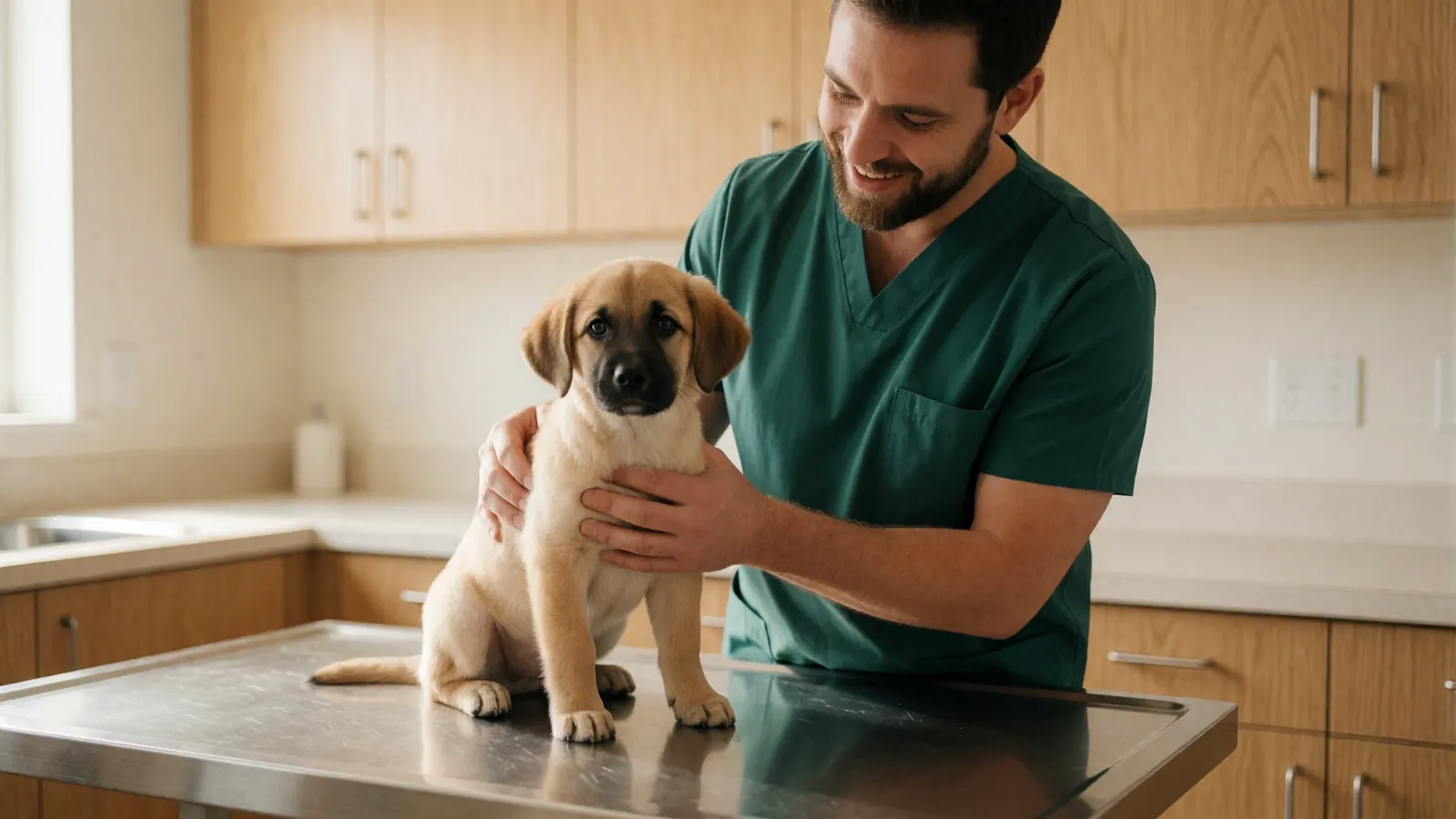
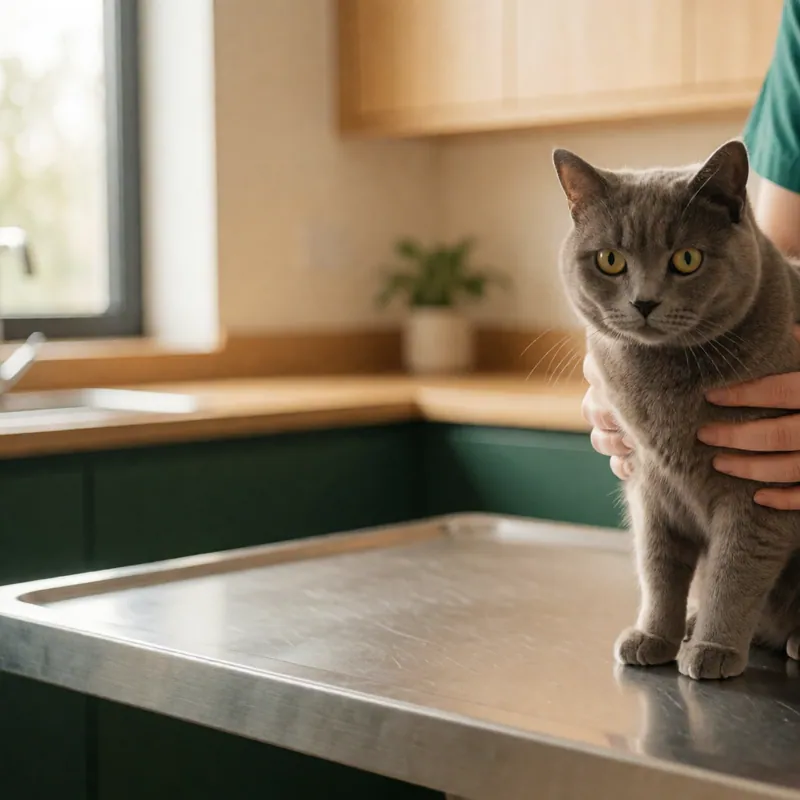
A cat's vaccination happens in a cat-only consulting room in the cat wing, not in a shared waiting area next to a row of dogs, because the appointment itself is calmer and the reading we take beforehand is more reliable in a quieter room. A dog's vaccination happens in one of the six general consulting rooms, on the same principle.
A record you can actually use
You leave with a written vaccination record showing exactly what was given and when the next one falls due, which matters for boarding, travel, dog walkers and groomers, and, for rabies specifically, any legal requirement to show current status if it is ever asked for. Keep your copy somewhere findable, but we also hold one on file here regardless, in case yours is ever misplaced.
What we watch for afterward
Mild tiredness or a sore spot for a day afterward is common and not a reason for concern on its own. If your animal shows swelling that keeps growing, repeated vomiting, difficulty breathing or collapses, that is different and should not be watched and waited on — call the practice straight away, or go to a 24-hour emergency animal hospital if we happen to be closed.
Priced plainly, with no bundled surprises
Dog core vaccinations are $42 each, cat core vaccinations are $40 each, and rabies is $35, whether given alongside a wellness examination or entirely on its own with no consultation attached. Nothing extra gets added to that figure once you are already in the room with your animal. See /pricing.html for how those numbers compare honestly with everything else we do here.
Vaccinations in western Queens
Core vaccines for dogs and cats, the rabies vaccination New York State requires, and an honest answer about titre testing — each priced plainly and given at the interval that actually protects your animal.
It starts the same way whatever you are here for: a full examination with time to talk, what we found explained in plain English, and a written estimate for anything beyond the consultation before it happens. You are entitled to take that estimate away and think about it, and to ask what happens if you do nothing. That last one is a real question and it gets a real answer.
This is general information, not veterinary advice. This page describes a service. It is general information and it is not veterinary advice, a diagnosis or a treatment plan for any particular animal, because no page can examine your pet. If your animal is unwell, injured or behaving unusually, speak to a licensed veterinarian who can actually see it. In an emergency contact your own veterinarian or a 24-hour emergency animal hospital immediately.
Questions
Vaccinations — the questions we are asked most
How much do pet vaccinations cost in Woodside, NY?
$42 per core vaccination for a dog, $40 per core vaccination for a cat, and $35 for the rabies vaccination, whether given alongside a wellness examination or on its own. A puppy or kitten first visit, which includes the first vaccination of the course, is $60. Every price includes the brief health check we do immediately before vaccinating.
What is the difference between core and non-core vaccines?
Core vaccines protect against diseases that are serious, widespread or both, and we recommend them for essentially every dog and cat — distemper, parvovirus and adenovirus plus rabies for dogs, panleukopenia, calicivirus and herpesvirus plus rabies for cats. Non-core vaccines, such as kennel cough or leptospirosis, protect against something real but narrower, and we discuss those against your animal's actual lifestyle rather than including them automatically.
Is the rabies vaccination legally required in New York?
Yes. New York State law requires a current rabies vaccination for dogs and cats, given as either a one-year or three-year vaccination depending on age and history. We keep the record current and can provide proof of it at any time, which matters if your animal is ever involved in a bite incident, is exposed to a wild animal, or needs to travel.
Where can I find the actual vaccination schedule for my puppy or kitten?
On /vaccination-schedule.html, which sets out the interval by age rather than a fixed list of dates, because the right timing depends on when your specific animal started the course. We deliberately do not publish a self-administered timetable here — getting the spacing wrong is the most common way a vaccination course fails to protect properly, so we confirm it with you directly at each visit.
What is titre testing, and can my pet have it instead of a booster?
A titre test is a blood test that measures your animal's existing antibody levels for certain core diseases, and for an adult dog or cat with a complete vaccination history it can show that a booster is not yet due. It does not apply to every vaccine — rabies boosters are governed by New York State law rather than a titre result — and we will tell you plainly which option genuinely fits your animal.
What happens if my pet misses a vaccination appointment?
It depends how late, and which vaccine, so call the practice rather than guessing. A course interrupted partway through very often needs restarting rather than simply resuming, because the protection depends on the spacing between doses, not just the total number eventually given. We would rather have that conversation honestly than let you assume the gap does not matter.
Are vaccinations safe, and what should I watch for afterward?
Most animals are entirely normal afterward, and mild tiredness or a sore spot for a day is common and not a concern. Watch for swelling that keeps growing, repeated vomiting, difficulty breathing or collapse — these are uncommon but genuinely warrant a call to the practice straight away, or a 24-hour emergency animal hospital if we are closed. We check your animal briefly before every vaccination for exactly this reason.
Can my cat be vaccinated somewhere quieter than a shared waiting room?
Yes — every cat vaccination happens in a cat-only consulting room in our separate cat wing, reached through its own entrance rather than the main waiting area. A calmer appointment is not just more pleasant for your cat; it also makes the brief health check we do beforehand more reliable, since a stressed reading is not the same as a resting one.
Related
Usually booked alongside this
Wellness & Prevention
Pet Care
Everything routine pet care covers in Woodside, NY, from a puppy's first visit through a senior's twice-yearly check-up, with the specific service, the actual interval and the price for each one.
Read more
Wellness & Prevention
Wellness Exams
A full nose-to-tail wellness exam for $75, or an extended senior health check with blood pressure and a senior blood panel for $145 — both including a written plan you actually leave with.
Read more
Wellness & Prevention
Parasite Prevention
Flea and tick treatment, heartworm prevention and worming, prescribed to your animal's actual weight rather than sold off a shelf, from $18 a month, with a $45 faecal screen for what a coat alone cannot show.
Read moreA written estimate before anything is booked
Book an appointment
We hold same-day appointments back on every single day of the week for animals that were well yesterday. Call the practice and describe what you have noticed, and the desk will book you at the right speed rather than the soonest one.