Is something wrong right now? If your pet is struggling to breathe, has collapsed, is bleeding heavily, cannot pass urine, has a swollen hard abdomen, is having a seizure, has been hit by a car, or has swallowed something you think is poisonous, this is an emergency. Call us before you set off so we can be ready for you, and if we are closed call a 24-hour emergency hospital straight away. Do not wait to see whether it settles. Call 000-000-0000
Urgent care here means a same-day appointment for an animal that has just become unwell, not a place in a queue for a routine slot three weeks from now. We hold back a block of same-day sick-visit appointments on every single day we are open, specifically for this, and the desk will ask what you have noticed so a veterinarian can decide how quickly you actually need to be seen. This is not the same thing as a 24-hour emergency hospital, and we will always tell you plainly which one your animal needs rather than book you in regardless of what is wrong.
Some situations should never wait for an appointment of any kind, same-day or otherwise. Difficulty breathing, sudden collapse, bleeding that will not stop, straining to pass urine without producing any, a hard and swollen abdomen, a seizure, being hit by a car, and a suspected poisoning are all reasons to call us before you decide how serious it looks, at any hour we happen to be open. Our job on that call is to tell you what to look for and exactly where to go next, not to talk you through treating anything yourself at home.
We are not open overnight, and nothing on this page should be read as suggesting otherwise. Within our hours — eight to seven on weekdays, nine to five on Saturday, ten to three on Sunday — call first if you can, so a veterinarian is expecting you when you arrive. Outside those hours, go straight to a 24-hour emergency animal hospital rather than waiting for us to reopen; we would rather your animal was seen elsewhere at two in the morning than seen by us the next day. See /emergency-checklist.html for what to keep ready, and /contact.html for how to reach us during the hours we are open.
The signs that mean call now, not later
None of these need to be confirmed by a website before you pick up the phone.
Difficulty breathing
Laboured breathing, open-mouth breathing in a cat, a cough that will not stop, or gums that look blue or grey rather than pink are all reasons to call before doing anything else. An animal working hard to breathe is spending reserves it cannot spare, and the gap between calling now and calling in an hour can be the gap between a manageable case and a collapse on the way here. Call us during our hours, and call a 24-hour hospital immediately if we are closed — do not wait to see whether it settles.
Sudden collapse or inability to stand
An animal that suddenly cannot get up, that goes limp, or that seems briefly unconscious has had a real event, whatever caused it, and needs to be seen straight away rather than watched for a few hours to see whether it happens again. If you can, note the time it happened and roughly how long it lasted, because that detail matters to whoever examines your animal next. Do not wait for a second episode to decide the first one was serious — it already told you everything you need to know.
Bleeding that will not stop
Blood that keeps coming after several minutes, that is coming from the nose, mouth or a body opening rather than an obvious cut, or that is enough to pool on the floor is not something to wait out at home. Keep your animal still and warm on the way to us and call ahead so we are ready. How alarming a bleed looks and how dangerous it is are different questions, and a phone call tells them apart faster than a guess — do not try to treat the wound yourself.
A hard, swollen or painful abdomen
An abdomen that has become tight, swollen or clearly painful to touch, especially alongside retching that brings nothing up, is one of the more time-critical emergencies there is — that pattern is typical of bloat in deep-chested breeds and can progress within hours. A male cat straining repeatedly in the litter tray and passing little or no urine is a similar emergency in miniature: a blocked bladder becomes life-threatening within a day or two. Call immediately in either case rather than waiting to see whether it resolves by morning.
Seizure, major trauma, or a suspected poison
A seizure, being struck by a car or falling from a height, or eating something you believe might be toxic are all reasons to call before you decide how serious it looks. During a seizure, note how long it lasted and what your animal did before and after, but keep your hands away from the mouth. With a possible poisoning, bring the packaging or the name of the substance if you have it, and call us or a 24-hour hospital immediately rather than waiting to see whether symptoms appear.
What happens when you call, or bring your animal straight in
The process is built to get the sickest animal seen first, not the one who arrived first.
The phone call itself
Whoever answers will ask what you have noticed, when it started, and whether your animal is eating, drinking and behaving normally — not to delay you, but to judge how quickly you need to be seen. Answer specifically; 'vomited twice this morning and will not touch breakfast' tells us more than 'he seems off.' If anything on this page's list of signs applies, say so, and if we think you should go to a 24-hour hospital instead, we will tell you on the phone rather than have you drive here first.
Being seen in the order it is safest, not the order you arrived
Same-day sick visits are seen in the order a veterinarian judges safest, which means an animal that looks stable may wait behind one that does not, even if it arrived later. You will be told honestly if that is happening and roughly how long the wait is likely to be, rather than left to guess in a waiting room. The consultation itself covers a full examination, a weight, and a plan — tests, a day admission, or medication to take home — explained before anything is added to your bill.
An IV line and oxygen started before the exam is even finished
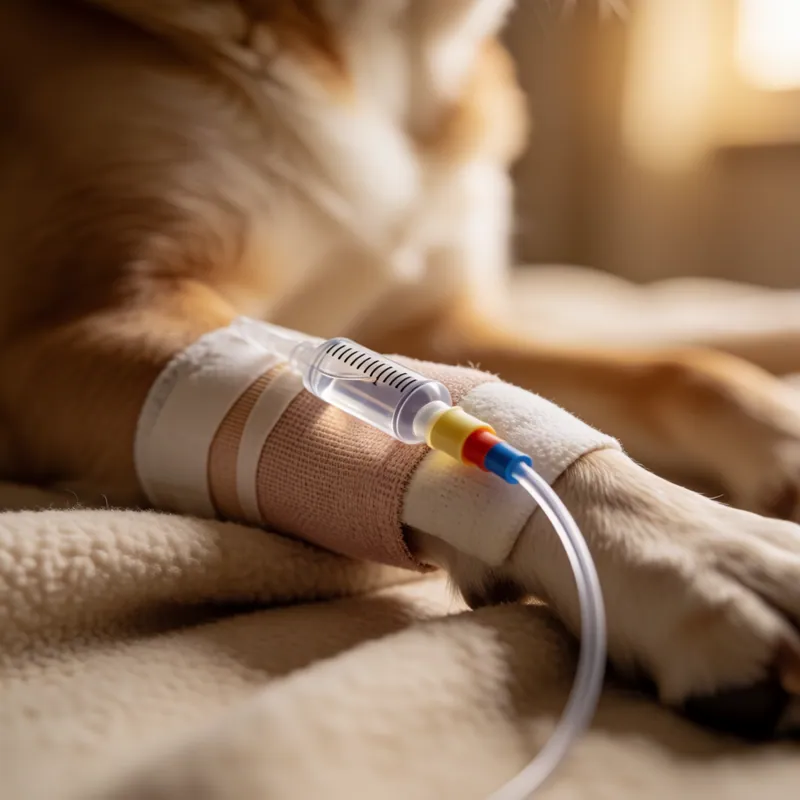
For an animal that clearly needs fluids, oxygen or medication straight away, we can place an intravenous line and start monitoring within minutes of arrival, sometimes before the full examination is even complete — stabilising first and asking questions second, where the two are genuinely in tension. This is routine, not a sign that something has gone especially wrong. A veterinarian will talk you through exactly what has been started and why as soon as your animal is settled enough for that conversation to happen properly.
A day admission, if your animal needs hours rather than minutes
Some animals need to stay with us for several hours under observation — on fluids, on oxygen, or simply where someone needs to keep watching them — without needing to stay overnight, which is not something we are set up to provide. A day admission is $55 and covers that supervision through the rest of our open hours. If your animal needs to stay past our closing time, we arrange the transfer to a 24-hour hospital ourselves and send your animal's full record with it, rather than leaving you to explain everything again.
What it costs, and when you are told
A same-day sick visit is $95 and includes the consultation itself; anything beyond that — bloodwork, imaging, admission, medication — is quoted in writing before it happens, even when the visit began as an emergency. Urgency changes how fast we work, never whether you are told the price first. If a particular test would not actually change what we do next, we will say so plainly rather than run it simply because it is available.
What urgent care here does not mean
Being honest about the edges of this service is part of the service.
It does not mean overnight cover
We are closed overnight, and nothing on this page is intended to suggest otherwise. Our hours are eight to seven on weekdays, nine to five on Saturday and ten to three on Sunday, and outside those windows the right call is a 24-hour emergency animal hospital, not a message left for us to hear the next morning. We will tell you this plainly on the phone if you reach us near closing time, and we would rather you drove further tonight than waited hours for us to reopen.
It does not mean treatment advice over the phone
We will tell you what we are hearing as a pattern and whether it needs to be seen now, later today, or tomorrow, but we will not talk you through giving a medicine, inducing vomiting, or carrying out any procedure at home, however calm and confident those instructions sound elsewhere. Animals are hurt this way more often than people expect. If it is safe for your animal to wait a few hours, we will say so and tell you what to watch for in that time; if it is not, we will say that too.
It does not mean medicating at home while you wait
Nothing from a human medicine cabinet is safe to give an animal on the assumption that it will help until you can get here — a number of ordinary household and human medications are actively dangerous to dogs and cats even in amounts a person would consider unremarkable. If your animal is in pain or distressed while you wait, the useful thing to do is keep them warm, keep them still, and call us — not to search for something to give them in the meantime.
It does not mean only the most dramatic cases
A same-day sick visit is also the right appointment for things that are not on the list of signs above but still should not wait for a routine slot — a limp that started this morning, one vomit with otherwise normal behaviour, an eye that has suddenly started weeping. Call and describe what you have noticed; the desk will tell you honestly whether it needs to be seen today. You do not need to decide that yourself, and it does not need to feel dramatic to justify making the call.
It does not end at the door
You leave with a written explanation of what was found, what was done, and a named person to call if something changes — and even though we cannot see your animal again until we reopen, we can still tell you what a worsening change would look like and where to take your animal if it happens overnight. See /emergency-checklist.html for what is worth keeping ready before you ever need this page, and /contact.html for how to reach us while we are open.
Urgent Care in western Queens
Same-day appointments held back every day for an animal that was well yesterday and is not well today, with plain guidance on the signs that mean call now rather than wait.
It starts the same way whatever you are here for: a full examination with time to talk, what we found explained in plain English, and a written estimate for anything beyond the consultation before it happens. You are entitled to take that estimate away and think about it, and to ask what happens if you do nothing. That last one is a real question and it gets a real answer.
This is general information, not veterinary advice. This page describes a service. It is general information and it is not veterinary advice, a diagnosis or a treatment plan for any particular animal, because no page can examine your pet. If your animal is unwell, injured or behaving unusually, speak to a licensed veterinarian who can actually see it. In an emergency contact your own veterinarian or a 24-hour emergency animal hospital immediately.
Questions
Urgent Care — the questions we are asked most
Are you open 24 hours a day?
No. We are open eight to seven on weekdays, nine to five on Saturday and ten to three on Sunday, and we are closed overnight. Outside our hours, the right call is a 24-hour emergency animal hospital, not a message left for us to hear in the morning. If your animal ends up there, tell them you are our client and we will send your complete records over the same day, so nobody has to explain the history twice.
How do I know whether this is an emergency or whether it can wait?
If your animal is struggling to breathe, has collapsed, is bleeding heavily, cannot pass urine, has a hard swollen abdomen, is seizing, has been hit by a car, or may have swallowed something poisonous, call immediately rather than deciding for yourself how serious it looks. For anything else that has changed today and does not feel like it can wait three weeks, call and describe exactly what you have noticed — the desk will tell you honestly whether it needs a same-day visit, a routine appointment, or a 24-hour hospital.
My dog ate chocolate — what should I do?
Call us immediately, or a 24-hour hospital if we are closed, and have the packaging or a clear idea of what and roughly how much your dog ate ready when you call. How serious this is depends on the type of chocolate, the amount, and your dog's weight together, which is exactly why a phone conversation matters more than a guess — the same facts can mean watch him closely tonight or come in right now, and that is a decision for a veterinarian on the phone, not one to make yourself at home.
Can I just bring my animal straight in without calling first?
Yes, during our open hours, though calling ahead means a veterinarian and a treatment space are ready the moment you arrive rather than you waiting for both to become free. If it is outside our hours, please do not drive here — we will not be open, and a 24-hour emergency hospital is the right destination instead. Calling first is especially worth doing if what you are describing matches any of the signs listed on this page.
How much does a same-day urgent visit cost?
A same-day sick visit is $95 and includes the consultation itself. If your animal needs to stay with us for observation, a day admission is $55 on top. Anything beyond that — bloodwork, imaging, medication — is quoted in writing before it happens, even when the visit started as an emergency, so urgency changes how fast we work rather than whether you see a price first.
What happens if my animal needs to stay overnight?
We do not have staff in the building overnight, so an animal that genuinely needs continuous overnight monitoring is transferred to a 24-hour emergency hospital rather than kept here unsupervised. We will stabilise your animal, explain exactly why the transfer is the right call, and send the full record with them so the next team is not starting from nothing. This is a small number of visits, but we would rather arrange it properly than pretend we can offer something we cannot.
Will someone talk me through what to do while I am on my way in?
We will tell you how to keep your animal calm, warm and still for the journey, and we will ask questions to prepare the treatment team for your arrival, but we will not talk you through giving a medicine, inducing vomiting or carrying out a procedure yourself. That kind of instruction is exactly how a frightened owner can make a bad situation worse, and it is not something any phone call should attempt.
I am not sure it is serious enough to justify calling — should I anyway?
Yes. The desk would always rather field a call about something that turns out to be minor than have an owner wait at home while something genuinely serious gets worse. Describe what you have noticed as specifically as you can and let a veterinarian decide how quickly it needs to be seen — that decision does not have to be yours to make alone, and nothing about calling commits you to an appointment you do not need.
Related
Usually booked alongside this
Urgent & Comfort Care
Anaesthesia & Monitoring
Continuous ECG, blood pressure, oxygen and temperature monitoring on every anaesthetic, watched by a named technician whose only task for that hour is your animal, with active warming throughout.
Read more
Urgent & Comfort Care
Pain Management
Animals hide pain and owners under-report it, so we look for it directly rather than wait to be told, then build a multimodal plan reviewed over time, not left unchanged for years.
Read more
Urgent & Comfort Care
Hospice & End-of-Life
Quality-of-life assessment while there are still good days, a private comfort room with its own exit and no time limit, home visits, and honest answers about what happens on the day.
Read moreA written estimate before anything is booked
Book an appointment
We hold same-day appointments back on every single day of the week for animals that were well yesterday. Call the practice and describe what you have noticed, and the desk will book you at the right speed rather than the soonest one.